
Guide · October 18, 2026 · 11 min read
Downsizing your home in Utah: the listing usually wins, and the gap between houses is the hard part.
Most of the planning goes into the months between one house and the next. Get those right and the rest of the sale is ordinary.
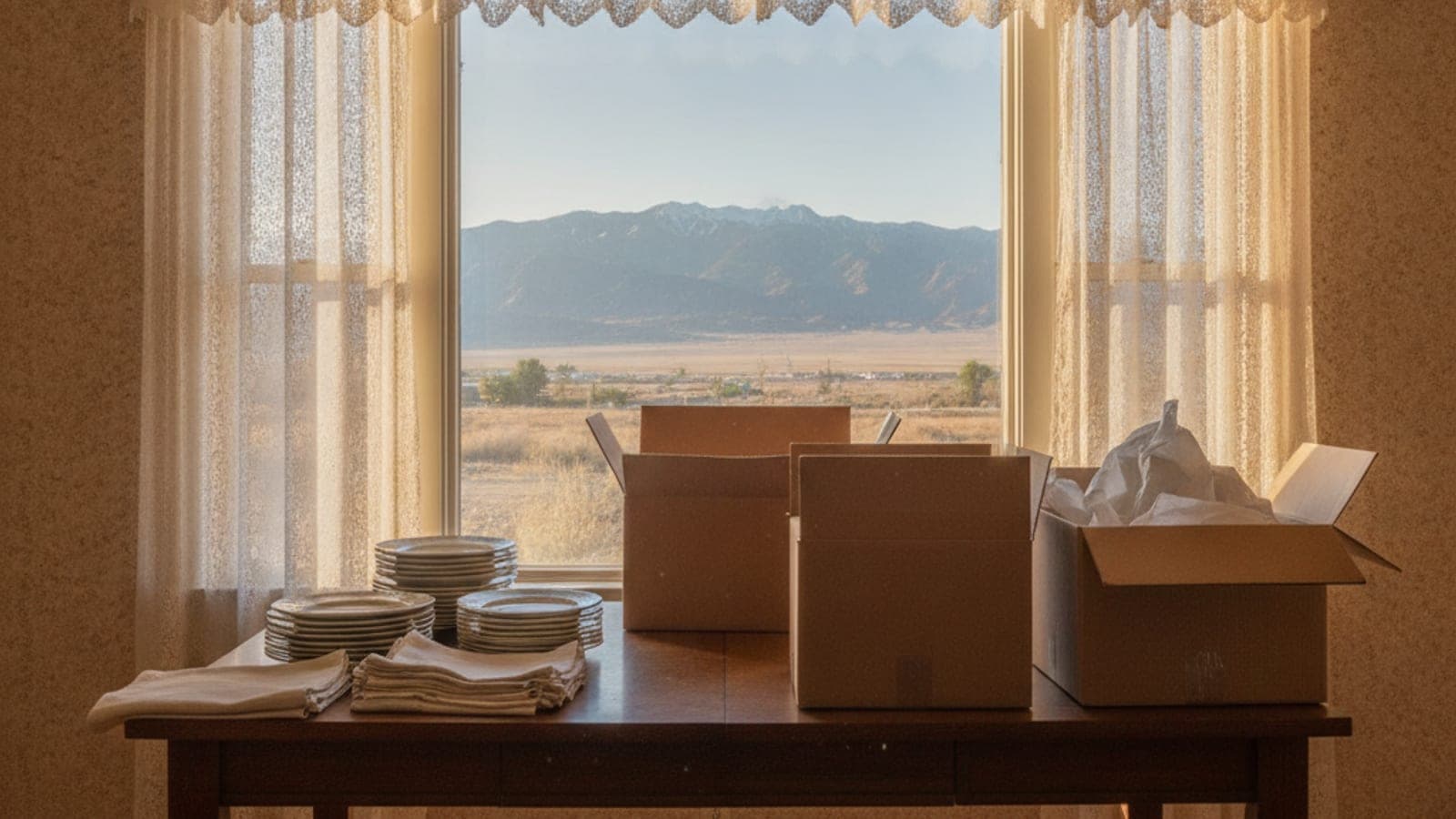
Downsizing your home in Utah usually goes best with a listing. If the house is paid off and nothing sets your date, an agent will usually net you more than a cash sale. The hard part is the gap: plan the months between selling one house and moving into the next, then pick the route that covers them.
Should you list with an agent or sell for cash when you downsize?
List with an agent, in most cases. A downsizer with a paid-off house in decent shape and no date pressing has what a listing needs: time, and a house that shows. A cash buyer, us included, pays less than a listing nets on that house, and we say so on the phone too.
With no mortgage to pay, the months a listing takes cost little. Utah houses spent a median 67 days on the market in September 2026, in Realtor.com’s figures published by the St. Louis Fed, and a financed buyer then needs about 37 days to close (ICE’s average was 36.8 days in March 2026).
A cash sale makes sense when two things are true at once:
- The move-in date is fixed. A builder’s closing date, a lease that starts, or a place in assisted living that will not be held.
- The old house cannot be shown. A spouse whose health rules out weekend showings, 40 years of belongings and no time to clear them, or repairs a buyer’s lender would flag.
If only one is true, a listing route usually still works. The full arithmetic of listing against a cash sale is on our cash buyer versus realtor page.
Where do you start when downsizing your home?
With the house you are moving to. Its size decides what comes with you, and its move-in date decides how the old house gets sold. Work in this order:
- Choose the smaller place and measure it. Look for a bedroom and a full bathroom on the main floor, since many townhouses put both upstairs, and read the HOA’s dues and rules before you sign. Then draw the furniture you want to keep onto the floor plan.
- Sort the belongings against that plan. Start with the rooms you use least: the basement, the spare bedroom, the garage. Give your family a date to collect what they want, then sell, donate or discard the rest. Start the sorting months before you list.
- Set the date, then pick the sale. The move-in date tells you how long a gap you can live with, and that narrows the routes to one or two.
A listing needs the house mostly empty or staged by photo day; a cash sale does not.
Should you sell first or buy first?
Sell first if you can live with a gap; buy first if you can carry two houses. In a downsizing home sale, each order trades a cost for a risk.
Selling first means you know your number before you commit, and you never pay for two houses. The cost is the gap: if the old house closes before the new one is ready, you rent, store the furniture and move twice, unless a later closing date or a rent-back covers it.
Buying first means one move, and the old house sells empty, which makes showings easy. The cost is carrying both until it sells, usually on a loan against it, and the risk is a sale that takes five months instead of three.
Keeping the old house as a rental is a third choice, weighed on our cash buyer versus renting page.
How much does it cost to carry two houses at once?
On example numbers, about $2,800 a month, or about $10K over the 3.5 months a Utah listing takes at the current pace, from the sign going in to closing.
Take a hypothetical Holladay couple. Their 1960s rambler, the kind of postwar house our Holladay page describes, is paid off and worth about $750K. They are buying a new $450K townhouse in Lehi, and the builder will close on a set day in May. They have $150K saved, so to buy first they draw $300K on a home equity line of credit against the old house. These are round examples, not a quote and not a sale we did.
| Monthly cost while they own both | Example figure |
|---|---|
| Interest on $300K at an example 8% | $2,000 |
| Property tax on the Holladay house | $400 |
| Insurance on the empty house | $150 |
| Utilities, yard care and snow removal | $250 |
| Total each month | About $2,800 |
| Over 3.5 months (67 days on the market, about 37 to close) | About $10K |
A HELOC rate usually floats as an index plus a margin, so the 8% is only an example. The CFPB’s HELOC booklet names the prime rate as a common index, and prime was 7.00% on October 13, 2026, in the St. Louis Fed’s series. The booklet also says a HELOC generally has to be paid off in full when you sell.
January 1 can add to the bill. Utah taxes a primary residence on 55% of its value, through the 45% residential exemption in Utah Code 59-2-103, allowed on one primary residence per household, with value set as of January 1. An empty house still yours on that date can be taxed on 100% of its value for the year, because Utah Code 59-2-102 counts unoccupied property as residential only if the county assessor decides it will be someone’s primary residence. At the same tax rate, that is a bill about 1.8 times as large: an example $4,800 becomes about $8,700. If the sale might run past New Year, call the county assessor first.
Set that $10K against a cash offer. On a $750K house in good shape, the gap between a cash offer and what a listing nets is usually far larger, so if the couple can get the line, buying first and listing the empty house beats selling to us. It changes if they must sell first: showings while they live there, and a closing that has to land before May. If one of them is unwell, or the house is too full to show, a cash sale on the builder’s date fits.
What are the ways to line up the sale with the move?
There are five: list first, buy first on a loan, make a contingent offer, sell for cash on your date, or sell and rent back.
| Route | How it works | What it costs | When it fits |
|---|---|---|---|
| List first, then buy | Sell with an agent, close, then buy with the proceeds | Commission and closing costs; rent, storage and a second move if the new place is not ready | You have time and somewhere to stay |
| Buy first with a bridge loan or HELOC | Borrow against the old house, buy, then list the old one empty | Interest and fees, plus carrying both houses (about $2,800 a month above) | You qualify for the loan and can carry both |
| Make a contingent offer | Your offer depends on the old house selling | A higher price, or losing the house to an offer with no condition | The house you want has sat, or its seller will wait |
| Sell for cash on a date you pick | A cash buyer closes on the day you need | A price below what a listing would net | The date is fixed and the house cannot be shown or needs work |
| Rent back after closing | Sell, close, and stay on for a set time | Any rent the buyer charges, and insurance on your belongings | The new place is ready days or weeks after the sale |
A bridge loan or a HELOC borrows against the house you are selling, and the CFPB’s HELOC page warns that if you fall behind, you could lose your home. A contingent offer is the box in section 2.2 of Utah’s state-approved purchase contract, and a seller with other offers will usually take one without that condition. A rent-back is a separate written agreement under section 3.3 of the same contract; on our purchases it goes in with an end date, though a later closing date is often simpler, as our post on how long a cash sale takes explains.
Do you pay capital gains tax when you downsize in Utah?
Usually not on the first $250,000 of gain, or $500,000 for a married couple filing jointly, if you owned the house and lived in it for at least 2 of the 5 years before the sale. That is the federal home sale exclusion in IRS Topic 701 and Publication 523. Gain is the sale price less your selling costs and your basis, which is what you paid plus the improvements you made.
Long-time owners should do the sum. Say the Holladay couple paid $150K decades ago, put $60K into a roof, windows and a kitchen, and sell for $750K with $45K in selling costs: their gain is $495K, just under the $500,000 joint limit. Utah’s income tax starts from federal adjusted gross income under Utah Code 59-10-103, so gain the exclusion removes generally stays off your Utah return too.
Publication 523 also has rules that help downsizers:
- Moving out first. The 24 months do not have to be continuous, so an owner who lived there at least 2 years can sell up to 3 years after moving out and still qualify.
- A surviving spouse. A surviving spouse who has not remarried can keep the $500,000 limit on a sale within 2 years of the death, if the other conditions are met.
- A move into care. If you can no longer care for yourself and lived in the home at least 12 months of the 5 years, time in a licensed care facility counts toward the 2 years.
The property tax break does not move with you either. The Utah State Tax Commission’s primary residential exemption page says it does not transfer automatically: you apply on the new place with that county’s board of equalization on Form TC-473A, on or before September 15, and late applications cannot be accepted. A gain over the limit, or a house that was ever rented, is a question for a CPA.
Questions people ask
How long does it take to sell a house in Utah when you are downsizing?
About 3.5 months from listing to closing at the September 2026 pace: a median 67 days on the market in Realtor.com’s Utah figures, published by the St. Louis Fed, then about 37 days for a financed buyer to close. Winter is slower: the same median was 85 days in January 2026 and 53 in March. A cash sale can close in as little as 7 days, or on a later date you pick.
Can I sell my house and stay in it until the new one is ready?
Yes, in two ways. A later closing date keeps you the owner until the day you sign, and on our purchases that date can be up to about 60 days out. Or you sign a written agreement to stay on after closing for a set time, which Utah’s standard purchase contract treats as a separate agreement.
What is a rent-back agreement?
A rent-back agreement is a written agreement that lets the seller stay in the house as a tenant for a set time after closing. It names the move-out date, any rent or deposit, and who pays for what. Utah’s state-approved purchase contract leaves each side to insure its own property, so keep coverage on your belongings until you are out.
Will a cash buyer take the furniture and everything else?
We will, on our purchases: you take what matters and leave the rest, and clearing the house is our cost, already inside the offer. That is one reason a cash offer is lower than a listing, so if you have time to sort and sell the contents yourself, the listing keeps that value with you. Ask any other buyer the same question, in writing.
Is there help with downsizing for seniors in Utah?
Start with your county’s aging services office. Utah’s Division of Aging and Adult Services lists a local agency for every county on its locations page, serving Utah residents 60 and older with home and community-based services. Salt Lake County Aging and Adult Services covers Holladay, and the Mountainland Department of Aging and Family Services covers Lehi and the rest of Utah County.
If the house is paid off, shows well and nothing sets your date, list it, and spend the months sorting. If the move-in date is fixed and the house cannot be shown, a cash offer is worth having in writing next to the listing estimate. Get your cash offer: it costs nothing and shows the figures behind it, and you are free to say no.
Find out what your house is worth in cash. Free, and no strings.
One phone call, or one short form. You'll have a real number by this time tomorrow.
Tell us about the house
Where the house is, your name, and a number we can reach you on. We call back within one business day, and you're free to say no.